

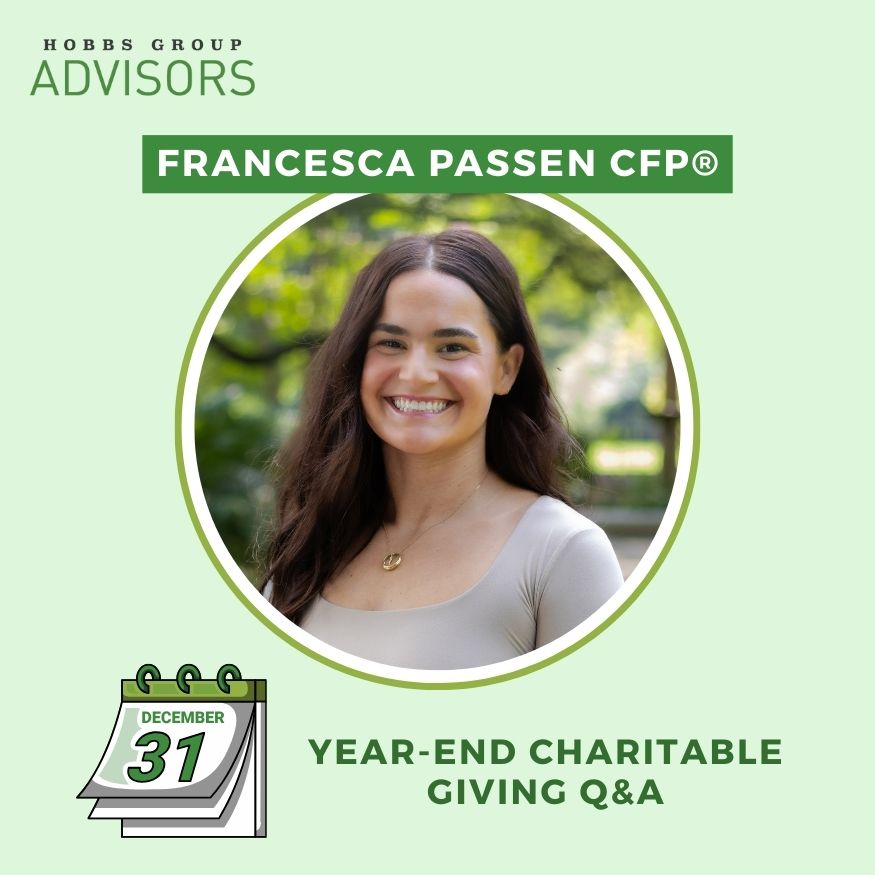
Year-End Charitable Giving: Q&A with Hobbs Group Advisor Francesca Passen
Thursday, December 11, 2025
Why is year-end such an important time to think about charitable giving?
- Many strategies must be completed by December 31.
- Helps maximize tax efficiency—especially for individuals with Required Minimum Distributions (RMDs) or high-income years.
- This is a great time to review goals and align giving with your financial plan.
Can you explain what a Qualified Charitable Distribution (QCD) is?
- A QCD lets people 70½ and older give directly from their IRA to charity.
- Up to ~$108,000 per year.
- Counts toward your RMD without increasing taxable income.
- Useful for managing Medicare premiums and Social Security taxation.
What common mistakes do people make with QCDs?
- Waiting until late December—custodian processing can delay.
- Taking the RMD first (you can’t retroactively convert it to a QCD).
- Sending the distribution to themselves instead of directly to the charity.
- Trying to send a QCD to a donor-advised fund—which is not allowed.
How do donor-advised funds (DAFs) fit into year-end giving?
- DAFs allow a donor to front-load giving—donate once, deduct this year, give later.
- Great for “bunching” deductions in a high-income year.
- Can donate appreciated stock to avoid capital gains.
What’s the biggest benefit of donating appreciated securities rather than cash?
- Double tax benefit:
- Avoid capital gains tax.
- Deduct full fair-market-value.
- Allows you to give more without extra out-of-pocket cost.
Why is gifting highly appreciated stock such a powerful charitable giving strategy?”
- Donating appreciated stock directly to a charity allows you to avoid paying capital gains tax on the growth.
- You also receive a full fair-market-value deduction for the shares you donate if you itemize.
- This means the charity receives the full value of the asset, not a reduced amount after taxes—so your gift goes further.
- It’s especially effective for long-term holdings with significant gains or for clients who want to rebalance a concentrated position in their portfolio.
- Many charities and donor-advised funds can accept stock directly, making the process smoother than most people expect.
Who is the ideal candidate for a donor-advised fund?
- Someone with high income this year (bonus, business sale, stock vesting).
- Retirees who want to set aside a pool for future giving.
- Families wanting to create a structured, long-term giving plan.
How do charitable strategies influence retirement planning?
- QCDs can reduce taxable income in retirement.
- Helps manage RMDs and avoid Medicare Income-Related Monthly Adjustment Amount (IRMAA) surcharges.
Is it possible to make charitable giving more tax-efficient for younger donors who don’t itemize?
- Yes—DAFs allow donors to bunch deductions into one year.
- Donating appreciated securities is still tax-efficient even if you don’t itemize.
- Company match programs can double impact to the charitable cause.
How should people choose between giving through a QCD or through a donor-advised fund?
- QCDs are for those 70½ and older and come from an IRA—ideal for people with RMDs.
- DAFs are flexible and good for multi-year giving but cannot receive QCDs.
- Many clients use both at different life stages.
What needs to be done before December 31?
- Review your giving plan now—don’t wait.
- Confirm custodian deadlines for QCDs.
- Look at appreciated securities for gifting.
- Make sure your giving aligns with your financial goals.